Are Your DBT Skills Improving? A 10-Minute Weekly Audit
By WithMarsha Team. Reviewed November 6, 2026 under WithMarsha editorial standards. Educational DBT skills content only; not therapy, diagnosis, treatment planning, or crisis care.
You remembered STOP forty minutes after sending the text.
Again.
It's easy to write that off as another week of skills you understand perfectly until you actually need them. But last month, you didn't notice what happened until the next morning. This time, you caught it before sending five more messages.
That difference deserves a place on your diary card.
Quick Answer
Evidence of your DBT skills improving can include recovering sooner after distress, remembering a relevant skill earlier, following through more often, or acting on fewer harmful urges. A weekly audit can help you notice those changes. Track four things: peak urge intensity, recovery time, time to remember a skill, and skill practice. Add one sentence about what you actually did.
These are practical review prompts, not a validated test or a deadline for getting better. The numbers won't always improve together.
Key Takeaways
- Look at behavior alongside feelings. A strong urge followed by a safer choice counts.
- Keep recovery time and skill recall separate: feeling manageable again is different from remembering what to try.
- Review weekly, then compare four-week blocks for a wider view. Add context for unusually hard weeks.
- Remembering afterward gives you something to rehearse. It doesn't guarantee faster recall next time.
- Bring stuck patterns to your therapist whenever you need help. You don't have to earn that conversation by practicing for a month first.
How Do You Know If DBT Skills Are Working?
Think about the last time you were actually activated. What happened between the urge and your next action?
Maybe you waited before replying. Maybe you asked for a break instead of disappearing for three days. Maybe you finished a difficult conversation shaking and still held the boundary you'd practiced.
Feeling better matters. So does getting through a hard moment with fewer consequences to repair.
DBT includes mindfulness, distress tolerance, emotion regulation, and interpersonal effectiveness, as described in the VA's DBT overview. Those skills have different jobs. A distress tolerance skill may help you get through a painful moment while the emotion remains intense.
For concrete practice options, see these IMPROVE DBT skill examples. Judge the attempt by what the skill was meant to help you do.
Why a rough Thursday can swallow a better month
When Thursday is still fresh, it's easy to forget the three times you handled something differently on Monday. Written notes give those moments somewhere to survive.
Clinical research also looks beyond a single day's mood. Linehan and colleagues' 2006 trial assessed treatment outcomes across a year of treatment and a year of follow-up. It studied comprehensive DBT for women with borderline personality disorder and suicidal behavior; it did not validate this four-number audit or evaluate WithMarsha.
Your weekly notes serve a smaller purpose: helping you and your therapist see what happened between sessions.
What Should You Track Each Week?
Choose one recurring situation or target behavior first. Impulsive texting, shutting down during conflict, and avoiding a difficult task may call for different skills. Mixing them into one score can make the pattern harder to understand.
Use your existing diary card where possible. Linehan's DBT Skills Training Manual provides the broader skills-training framework. This audit is an optional summary of your practice, not a replacement for the tracking your therapist has asked you to do.
| Measure | What to record | What to keep consistent |
|---|---|---|
| Peak urge intensity | The strongest urge in each logged episode, from 0–10 | Track the same target urge. Use the highest recorded peak for your weekly summary. |
| Recovery time | Approximate time from the spike until distress became manageable | Define manageable, such as being able to return to a task or make a deliberate choice. Summarize the typical time across logged episodes. |
| Time to remember a skill | During the moment, minutes later, hours later, or the next day | Record when a relevant skill came to mind, even if you didn't use it. |
| Skills used per week | Deliberate practice attempts, including practice while calm | Use the same counting method and briefly note whether an attempt helped. |
Recovery time can be especially useful if distress is taking over large parts of your day. But it isn't the only measure that matters. If you recover just as slowly and avoid a harmful behavior more often, record that too.
Under the four numbers, add: What did I do when the urge showed up?
“Wanted to send another message. Put my phone down and waited.”
That sentence can explain more than a lower rating.
A worked six-week example
This is an illustration, not a timetable. Recovery and recall describe typical logged episodes; urge peak is the highest recorded that week.
| Week | Recovery time | Urge peak | Time to remember a skill | Practice attempts |
|---|---|---|---|---|
| 1 | About 90 minutes | 9 | That evening | 2 |
| 2 | About 75 minutes | 9 | Hours later | 3 |
| 3 | About 80 minutes | 10 | About 30 minutes | 4 |
| 4 | About 50 minutes | 8 | About 10 minutes | 5 |
| 5 | About 60 minutes | 9 | During some episodes | 4 |
| 6 | About 40 minutes | 8 | During some episodes | 5 |
Week three was hard. Week five went backward on several measures. Across the full six weeks, recovery got shorter and skills started coming to mind earlier.
WithMarsha newsletter
Practice DBT between sessions
Get practical DBT exercises, worksheets, and new skills in your inbox
The next question is whether remembering led to action. A rising practice count alone doesn't answer that. More attempts might reflect more opportunities, more distress, or repeated attempts with a skill that didn't fit.
How to Keep the Weekly Audit Under 10 Minutes
Set a recurring reminder and open your diary card or notes. If you're starting from scratch, use this guide to DBT diary cards.
- Pull out the numbers. Summarize what you logged. Leave missing information blank rather than inventing precision.
- Add context. Note poor sleep, illness, a major conflict, fewer triggers, extra support, or changes in treatment.
- Find one useful moment. Where did you pause, practice, ask for help, or interrupt a familiar behavior?
- Choose one adjustment. Make next week's practice specific enough to remember.
“Get better at emotional regulation” gives you very little to do.
“When I notice my jaw tightening during a difficult conversation, I'll pause before replying” gives you a place to start.
If recall is the sticking point, use these ideas for remembering DBT skills in the moment. Keep the next skill somewhere you can find it when you're overwhelmed.
How to Review Your Diary Card Without Letting One Week Decide Everything
Every four weeks, compare the recent block with the previous one if you have enough records. Look at similar situations and use the same definitions throughout.
Are you recovering sooner after conflict? Remembering skills earlier? Following through more often? Experiencing fewer consequences afterward?
There's no magic rule that three improving weeks prove a trend. Four-week comparisons are a practical review rhythm, not a clinical cutoff.
A week with fewer triggers may look better for reasons beyond practice. A harder month may hide progress that becomes visible only when you look at how you handled comparable episodes. Urge intensity, recovery, and crisis frequency don't follow a universal order of improvement.
Missing entries mean you don't know what happened. They don't automatically mean you got worse. Record how many days you tracked so you can tell the difference between a quieter week and a less documented one.
When the pattern centers on acting quickly to escape discomfort, pair your review with DBT skills for impulsivity and identify one earlier opportunity to pause.
What If You Only Remember Skills Afterward?
There's still useful work available. Identify the earliest cue you can remember, choose a skill that might fit, and rehearse what using it would look like.
“My chest tightened when I read the message. Next time, that's my cue to put the phone down and use STOP before replying.”
Be accurate about what you're counting. Naming a skill afterward is reflection. Practicing it afterward is practice. Using it during the situation is another step. All three can give you useful information.
For predictable situations, you can also rehearse ahead of time, such as practicing boundaries with family before a visit.
How long until skills feel automatic?
There isn't a universal countdown. The often-quoted “66 days” comes from Lally and colleagues' habit-formation research, which studied everyday eating, drinking, and activity behaviors. It wasn't a study of DBT skills during emotional crises. Modeled times varied widely.
Use that research as a reason to be cautious about deadlines. Your more useful question is whether the skill is becoming easier to access in the situations you're practicing for.
What to Do When Progress Feels Stuck
A couple of flat weeks are worth looking at. They don't diagnose a plateau or tell you why it happened.
Start with the specific point where practice breaks down:
- You notice the emotion but don't remember a skill. Pick one relevant skill, attach it to an early cue, and rehearse the first step when you're calm.
- You remember the skill but don't use it. Explore the obstacle. Is the skill awkward to use there? Hard to start? Does acting on the urge feel more compelling? Bring that detail to session.
- You use a skill and still feel awful. Check what you expected it to do. Did it help you avoid making things worse? If repeated attempts aren't useful, review the situation and skill choice with your therapist or DBT group.
- Tracking has become a chore you avoid. Make the entry smaller. One urge rating and a sentence recorded soon afterward may be more useful than a detailed card reconstructed days later.
Work through three questions: Are the notes accurate enough to use? Does the skill fit the situation and goal? Can you identify an earlier cue to practice with?
Choose one manageable adjustment so you can notice what happens next. If you're unsure which skill fits, explore the DBT skills library and bring a specific example to your therapist.
When to Bring Your Tracking to Therapy
Bring it whenever you need help. You don't have to wait four weeks or prove you've practiced hard enough.
Persistent distress, repeated harmful behavior, skills that feel unusable, or tracking that adds shame are all worth discussing. If several weeks show little useful change, your notes can help you review what needs adjusting.
Try opening with:
“My urges still reach an 8. I'm recovering faster, but I usually remember a skill after I've sent the message. Can we work through that moment and choose something I can practice earlier?”
Bring the numbers and enough context to explain them. The story matters too.
When this audit may not fit
If tracking becomes compulsive, increases self-criticism, or overwhelms you, ask your therapist about simplifying or adapting it. Don't add four new measures just because an article suggested them.
If you're in immediate danger or think you may act on urges to harm yourself or someone else, seek urgent human support through local emergency or crisis services. Don't wait for the weekly review.
Which Tools Make Weekly Tracking Easier?
Choose by what you need to do: enter a note quickly, find a skill during distress, review past entries, and share useful information with your therapist.
| Tool | Useful for | Check before relying on it |
|---|---|---|
| Paper diary card | Using your therapist's exact format | Whether you can keep it accessible and review it consistently |
| Phone note or spreadsheet | Recording these four measures in your own format | Whether setup and data entry stay manageable |
| Dedicated diary card app | Keeping entries together on your phone | Current tracking fields, history, sharing options, and cost |
| WithMarsha | Diary cards, skill guidance, and between-session practice | Whether its fields and weekly export match what you need for sessions |
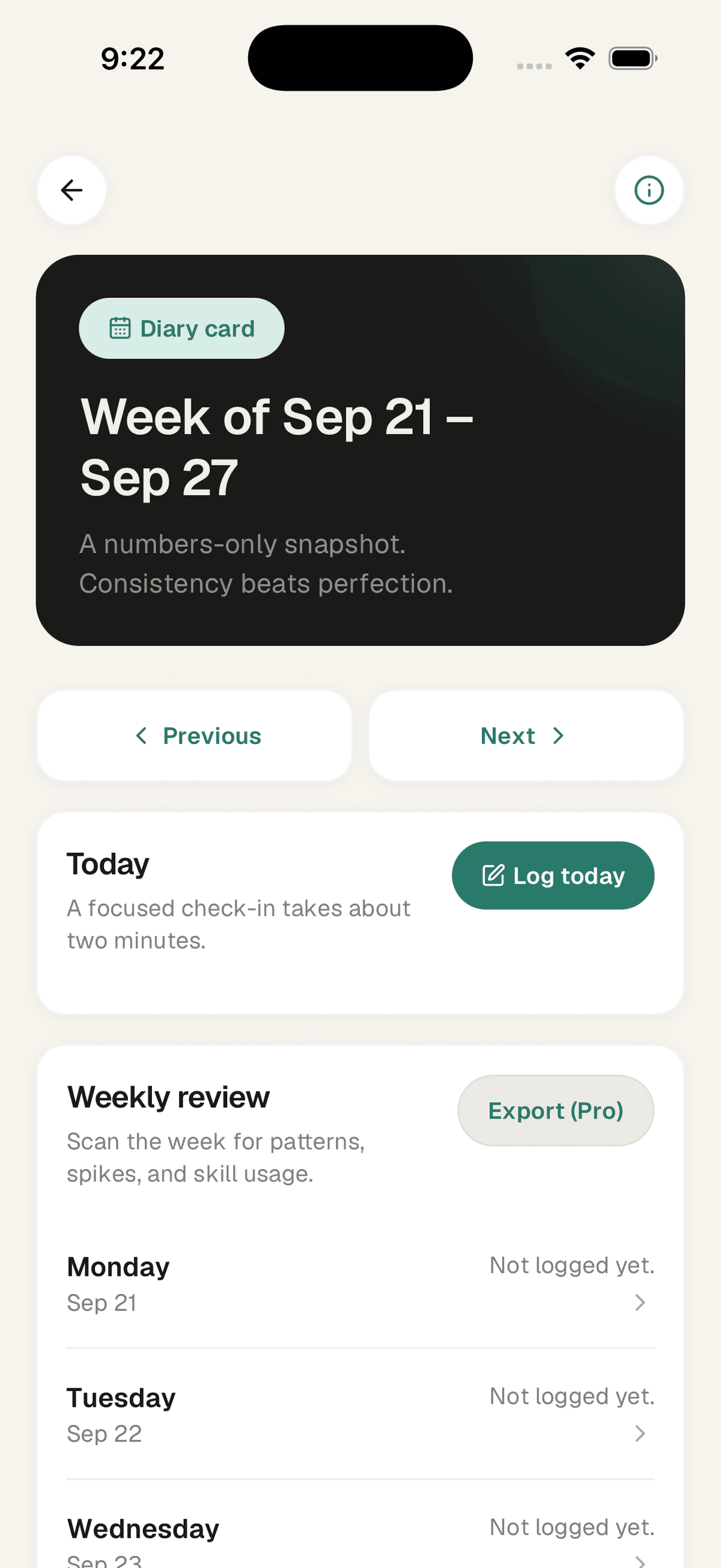
WithMarsha supports weekly diary-card PDF export with Pro. If you need custom recovery-time or recall measures, keep a short companion note or spreadsheet. Bring the format your therapist can actually use.
WithMarsha is an educational practice companion, not therapy or crisis care. An app can help you keep skills close; interpreting treatment progress still benefits from professional support.
Frequently Asked Questions
Can I track DBT progress without a diary card?
Yes. A consistent phone note or spreadsheet can capture urge intensity, recovery time, when a skill came to mind, and what you practiced. Add what happened next. If your therapist uses a specific diary card, discuss changes before replacing it.
Is it normal to feel like DBT isn't working after a few months?
It can happen, and the feeling deserves attention. Compare your written notes for changes in behavior, recovery, and skill use, then discuss your concerns with your therapist. A rough month doesn't prove treatment has failed, and persistent difficulty shouldn't be dismissed as impatience.
What if I only remember skills after the crisis is over?
Use the review to identify an earlier cue and rehearse a relevant skill. Record reflection separately from in-the-moment use. Remembering afterward can support practice, but it doesn't guarantee that recall will get faster on a particular schedule.
How do I show my therapist my progress between sessions?
Bring your diary card, tracking note, or export, plus one specific episode. Explain what changed and where you got stuck. For example: urge intensity stayed high, recovery got shorter, but you still remembered the skill after acting. Ask to work through that moment together.
Sources
- Guilford Press: DBT Skills Training Manual — The broader DBT skills-training framework.
- VA South Central MIRECC: Dialectical Behavior Therapy — Public overview of DBT treatment and skills modules.
- Linehan et al. (2006): Two-year randomized controlled trial and follow-up — Comprehensive DBT treatment research; not validation of this audit or an app.
- Lally et al. (2010): How are habits formed? — Everyday habit formation and variation in automaticity; not a DBT timeline.
Give Progress Somewhere to Show Up
At your next weekly check, look for the moment you gave yourself another option.
You paused. You asked for help. You remembered sooner. You stopped after one message.
Write it down while you can still see it. Then choose one skill to practice again. If you want help keeping that practice close, explore WithMarsha.
Practice DBT skills with WithMarsha
Keep a structured DBT skills library, guided practice, and daily reflection close when real life gets complicated.


WithMarsha newsletter
Practice DBT between sessions
Get practical DBT exercises, worksheets, and new skills in your inbox